How a Food Safety Auditor Mastered the HIH Conference Under Pressure
A data-driven breakdown of optimizing delivery mechanics from 166 WPM to 123 WPM by leveraging personal storytelling.

Specialist in Speech Biomechanics. Helping leaders measure and optimize spoken delivery.
Executive Summary / TL;DR
- The Challenge: Narmada, a hospitality auditor, was rushing her material at 166 WPM. Her baseline content was 51% Intangible and only 4% Personal, resulting in a low Grade of 51.7 / 100.
- The Solution: Utilizing a 4-week THPS Performance Plan, she simulated audience pressure to intentionally lower her Runtime to 5.5 seconds and shift her focus to vivid, story-driven case studies.
- The Result: For the HIH Conference, Narmada optimized her pace to a confident 123 WPM, shifted her content to 59% Personal and 18% Visual, and achieved a final Grade of 96.0 / 100.
Interactive Tool: Test Your Speech Mechanics
Live BiometricsTry Narmada's Simulated Exercise
Click to load the free verision of the Mic-Check App. See your own speech metrics and practice improving how you speak.
Start Mic-Check AppThe browser app requires microphone permissions to analyze your delivery.
The Baseline Challenge: High Runtimes and Intangible Data
Narmada is a senior auditor evaluating food safety and dysphagia standards across hospitality and aged-care facilities. When she was tapped to deliver her first major presentation at the Hospitality in Healthcare (HIH) Conference, the pressure triggered immediate Skill Inhibition.
During her initial THPS Speech Assessment, the baseline data revealed exactly how the pressure was manifesting:
- Her pace was pushing 166 WPM, making it difficult for listeners to digest her dense regulatory criteria.
- Her Runtime stretched to 12.6 seconds before she took a noticeable breath, resulting in a rushed, continuous delivery.
- Her content scored 51% Intangible and only 4% Personal. She was relying entirely on abstract facts rather than engaging case studies.
The Intervention: Simulating Pressure
To prepare for the HIH Conference, we transitioned into the 1-on-1 THPS Performance Plan. To reduce her 12.6-second Runtime, Narmada needed to build muscle memory around deliberate, structural pauses.
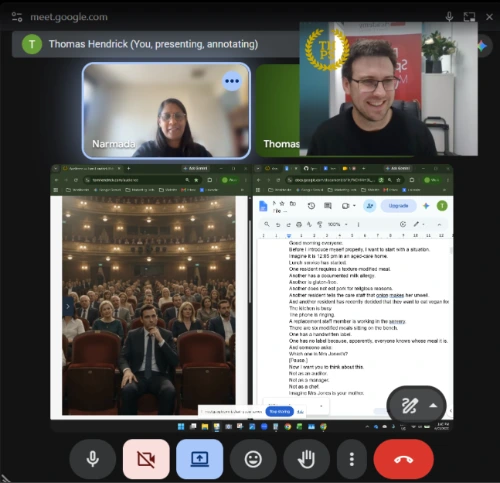
We completely restructured her presentation content. Instead of quoting regulatory guidelines, we drafted a deeply Visual and Personal narrative. We anchored her speech to a vivid, high-stakes scenario: "Imagine it is 12:05 pm in an aged-care home... One resident requires a texture-modified meal. Another has a documented milk allergy."
The Final Result: Authority Through Pacing
By Session 4, the transformation in her Mic-Check dashboard was profound. By leaning into personal storytelling, her content metrics shifted to 59% Personal and 18% Visual. Because she felt emotionally connected to the material, her pace naturally dropped to an authoritative 123 WPM, and her Runtime normalized to 5.5 seconds.
She walked into the HIH Conference not just surviving the presentation, but commanding the room with a final grading of 96.0 / 100.
Narmada Oogathoo
"I am extremely grateful to Tom Hendrick for helping me thrive (not just survive) my first major conference presentation at HIH Conference... I was impressed that Tom's approach to public speaking coaching uses technology and structured skill acquisition exercises. The training was extremely fun, highly tailored to my needs, and taught me a lot about how to prepare and deliver a presentation under pressure. I highly recommend booking a THPS Speech Assessment and checking out Tom's Mic-Check App."Verified Google Business Review
How the Mic-Check Scorer Engine Measures Your Spoken Voice
Unlike basic word-counting scripts, our proprietary THPS.analyzeSpeech engine evaluates spoken audio across multiple biomechanical dimensions in real time:
We calculate syllable counts per word token and map gaps against expected syllable unit lengths. A pause is classified as a structural breath or cadence break only when silence exceeds 700ms to 750ms.
Continuous speech runs between structural pauses are classified into absolute cadence tiers: >5.0 SPS (Too Fast), 3.8–4.2 SPS (Optimal Command Zone), and <3.0 SPS (Drag Zone).
Spoken energy is continuously grouped using biological decibel thresholds (±3dB and ±9dB relative to the speaker’s average spoken word intensity) to track dynamic contrast vs. monotone strain on a real-time Voice Graph.
Transcripts are evaluated against normalized dictionaries (including 10k Common Words and Visual Imagery corpora) to calculate grade level, narrative pronoun density, and visual clarity without relying on subjective opinions.
Stop Guessing. Start Measuring.
Get your own baseline analytics and discover the exact metrics holding back your communication.