
Get your 1 hour THPS Speech Assessment for free
The signs you’re ready to book a free THPS Speech Assessment
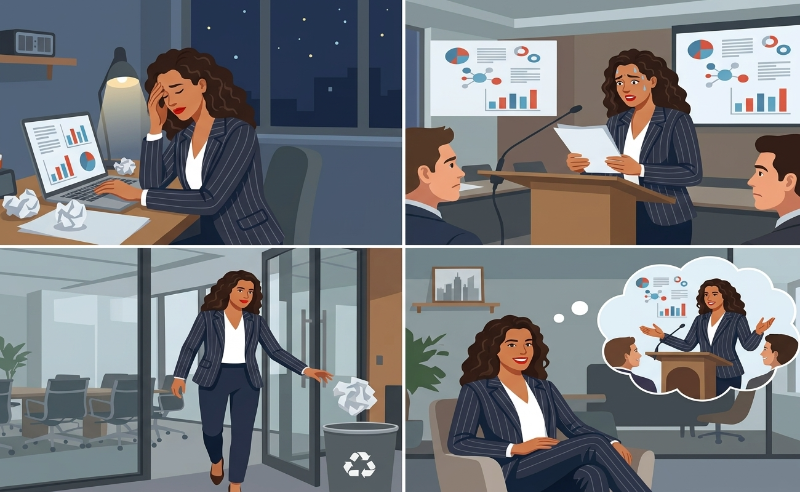
Sonja is a capable professional, who has lots of important presentations and conversations in her role.
She knows her stuff, but preparing for presentations feel exhausting. She doesn’t want to over-rely on clunky scripts. Scripts take away her natural delivery. But without scripts, she worries about speaking over time or forgetting things.
Despite feeling uncomfortable, she’s getting "okay" results, but she always thinks of better things to say after she leaves the room.
Sonja wants to truly excel, not just survive, when she has important presentations and conversations.
What happens when you book your THPS Speech Assessment?
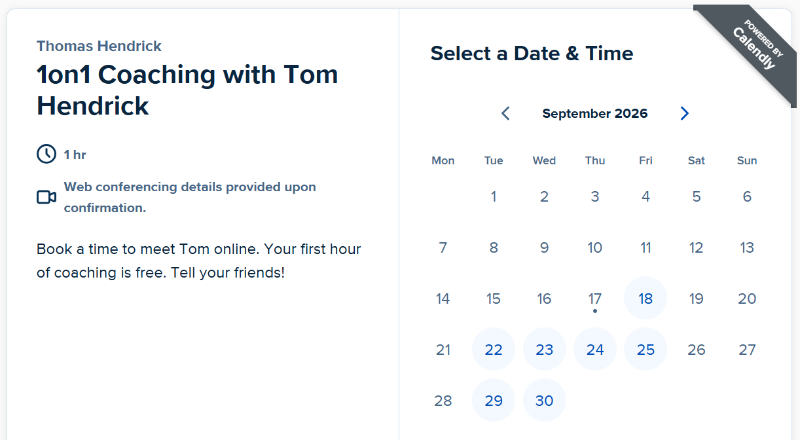
Sonja decided to use the booking link to book her free 1 hour THPS Speech Assessment.
She had the option of meeting Tom Hendrick (an award winning Communication Coach) online or in person.
Sonja met Tom in his office in person.
Tom explained the parts of the Speech Assessment:
Sympathetic Adreno-medullary Questionnaire (measuring your nerves in different scenarios)
Vividness of Visual Imagery Questionnaire (if you think better with images or concepts when speaking without a script)
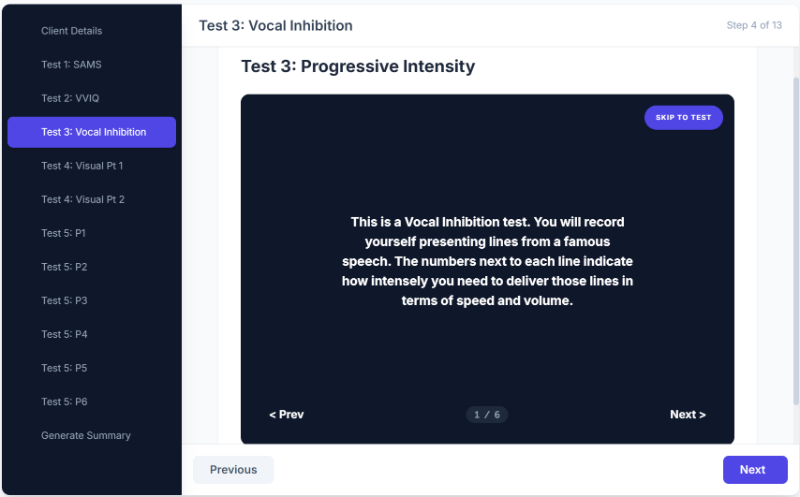
Vocal Inhibition Test (measuring discomfort speaking loud, quiet, fast or slow)
Image-based Speaking Test (measuring speaking fluency with images and memories)
Rules-based Speaking Test (measuring speaking fluency with rules and categories)
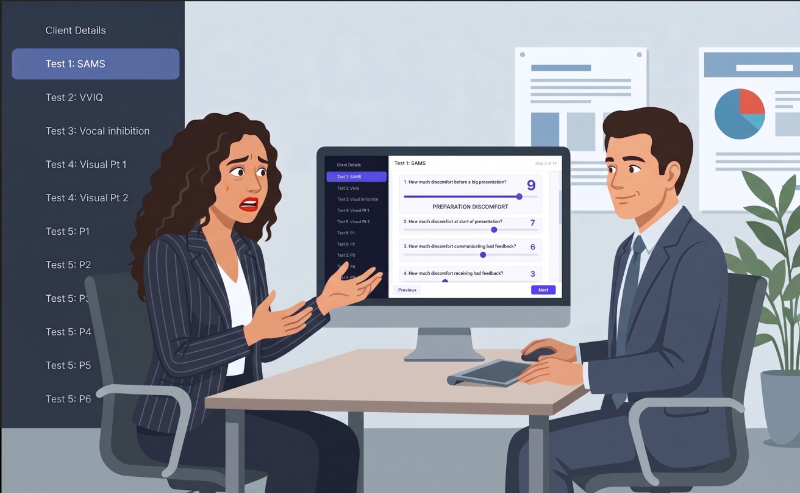
Nerves can take away the speaking skills you have under pressure.
Tom started the Speech Assessment by taking Sonja through the SAMS Test.
SAMS stands for Sympathetic Adreno-medullary System, which is a neuro-hormonal process of:
a speaker detecting cues during their presentation / conversations (e.g. sights, sounds, thoughts such as what the audience looks like, what they say, and whether uncertain thoughts come to mind);
the speaker’s amygdala (a part of the brain that “interprets / predicts” signals as threatening) “alerting” the adrenal gland via the hypothalamus and spinal cord;
the adrenal gland causing the body to produce higher heart rate, more stress, more adrenaline, etc;
the speaker to notice themselves feeling more comfortable or less comfortable, and thus repeating the cycle in a self-regulating or self-dysregulating way (getting more nervous or less nervous).
Sonja provides scores from 1 to 10 about how much discomfort she feels speaking in different situations.
Tom compares her scores to hundreds of others that have taken the SAMS test.
Sonja scores better (less nervous) than most people when actually presenting, but much worse (more nervous) when thinking about presentations.
Sonja discovers she has a Preparation Dysregulation gap.
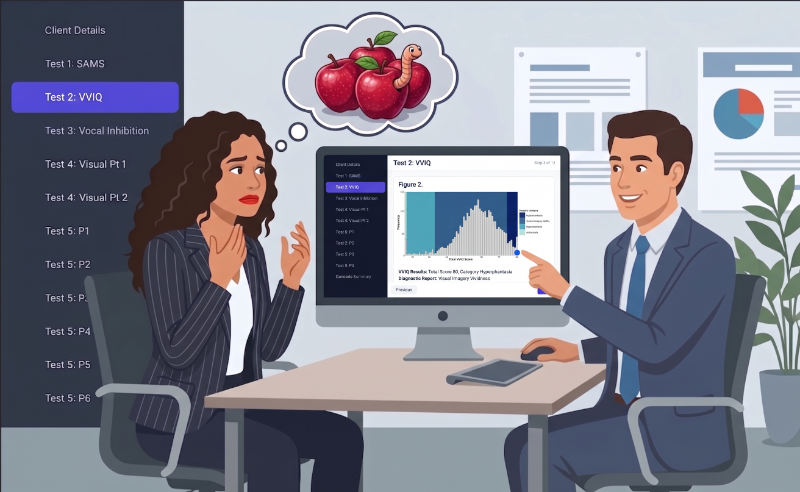
Why your VVIQ score is related to how you speak without a script
Sonja was taken through the VVIQ (vividness of visual imagery questionnaire). The VVIQ is a series of questions and visual descriptions. It tested Sonja’s ability to effortlessly imagine, animate and control images in her mind. Everyone is on a spectrum, from:
Aphantasia (<2% of the population)
An inability to see images in your mind. This makes it hard (but not impossible) to recall memories / diagrams / stories vividly when speaking.
Hypophantasia (~12% of the population)
Tom Hendrick has Hypophantaisa. This means it takes effort to see images in your mind and those images might be disobedient an not vivid. This makes it hard (but not impossible) to give specific examples when speaking.
Phantasia (~80% of the population)
Most people can recall or see images in their mind effortlessly with complete control when speaking.
Hyperphantasia (~6% of the population)
Sonja can effortlessly see images in her mind, which causes more images and details to come to mind involuntarily. This might explain why she is very nervous thinking about important presentations, but comfortable speaking without a script.
Sonja discovers she has Hyperphantasia.
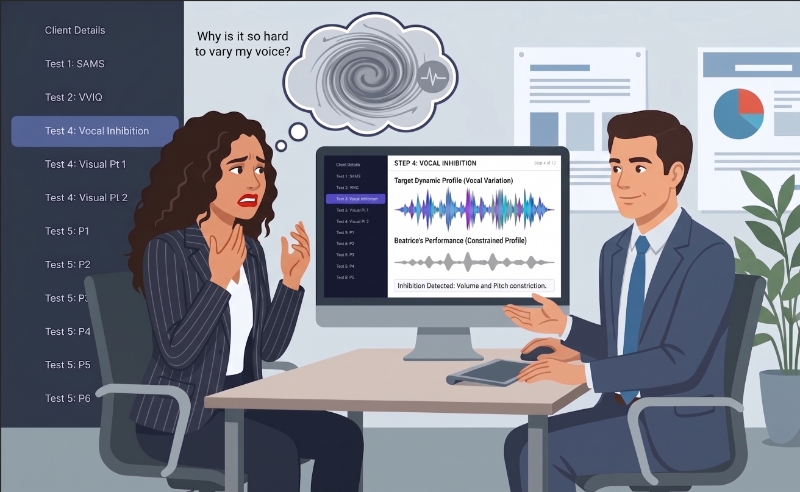
Why Vocal Inhibition affects how you speak under pressure
Sonja was taken through the Vocal Inhibition Test.
Tom demonstrated the test by first performing a famous speech script from a movie.
He had to modulate his voice on command in response to instructions in the script for each line.
Some lines were dramatically slow and serious and quiet.
Other lines were in a normal voice.
Other lines were delivered extremely loud and fast.
Tom demonstrated a broad range of effortless vocal modulations (fast, slow, loud, and quiet).
But when it was Sonja’s turn, she didn’t feel comfortable moving her voice very far from her usual speaking voice.
She was capable of speaking slow, fast, whispering or shouting… but for some reason, her brain wouldn’t let her voice do so on command.
Sonja only passed 3 out of 5 voice modulations, but the average score across everyone assessed was 1.8 out of 5.
Sonja was relieved that her Vocal Inhibition was above average; kind of like how most people can’t touch their toes.
Sonja discovered she has a minor Vocal Inhibition Gap.
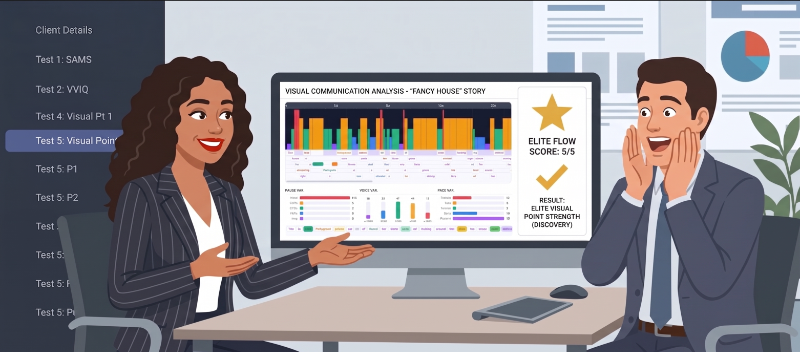
Your Speaking Fluency might be better with Image Prompts than Category Prompts
Sonja was taken through the Image-based Speaking Test.
Tom gave Sonja an image of a run-down house and instructed her to speak slowly (<100 words per minute), using visually descriptive words (e.g. describe the colour and size of the house, any objects and their location, etc).
Tom recorded Sonja’s presentation using his Speech Analyzer App. Her results were incredible! She spoke at 97 words per minute, and 58% of her words were visually descriptive.
Sonja was so effortless at finding the visual words to describe the image, that slowing down was the hard part!
Tom then took the image away, and instructed Sonja to visually describe an incredible new house using only her imagination. She also had to speak much faster than her usual pace (>170 words per minute).
Sonja actually found this test easier than the first! Her hyperphantasia imagination was let loose, and she recorded an incredible 68% visual content score at 220 words per minute!
No wonder scripts made Sonja feel unnatural - her brain wants to get the vivid images out of her head quickly!
Sonja discovered she had a significant Image-based Communication Strength!
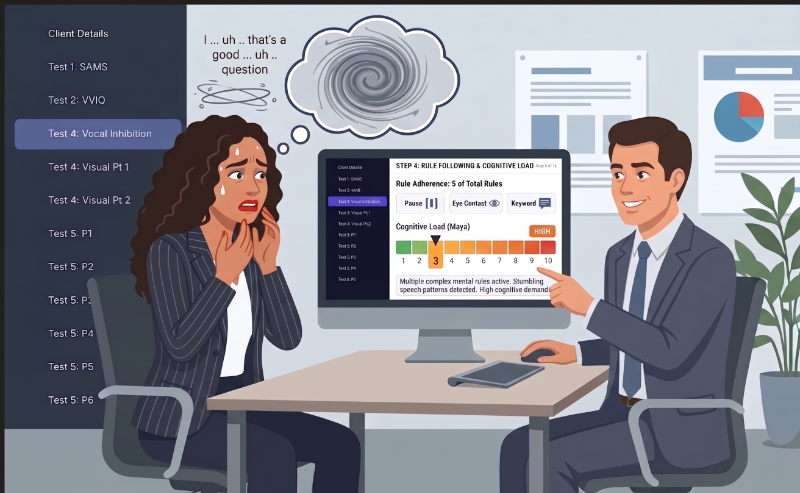
Find out how much Cognitive Load you can take before your Speaking Fluency drops
Sonja was taken through the Rules-based Speaking Test.
She was feeling overly confident from her success at the Image-based Speaking Test.
But Tom Hendrick told Sonja that the Speech Assessment benchmarks suggest most people with high Hyperphantasia tend to get low Rules-based scores.
Tom asked Sanja 6 rounds of 5 questions. Sonja had to answer 5 questions while following an increasing number of rules to test how cognitive load affects her speaking fluency:
In Round 1: Sonja was only allowed to respond by saying a word that was underlined in the question. She passed Round 1, but she noticed her brain really wanted to give a full answer.
In Round 2: Sonja was only allowed to respond by saying one or two words from the question, and she had to pick them herself (they were not underlined). She passed Round 2, but her scores showed a significant delay and hesitation in her responses.
In Round 3: Sonja was only allowed to respond by re-stating the entire question, while using her voice to emphasize the most important word to her. Sonja was surprised that she could not pass Round 3. Her brain hesitated at the idea of repeating the question and this distracted her from remembering to emphasize a single word.
Tom said the average participant fails at Round 4 of 6, but Hyperphantasia participants show signs of struggle at Round 1. Aphantasia participants can complete Round 6 without mistakes.
Sonja discovered she had a significant Rules-based Communication Gap.
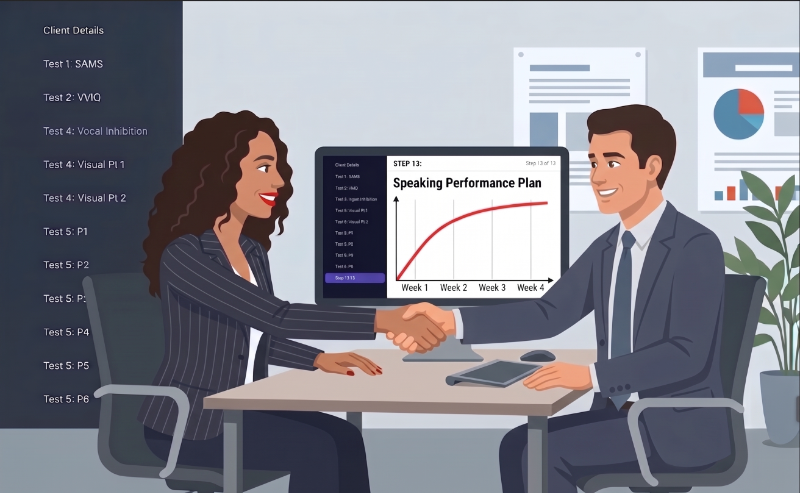
Your Free Speech Assessment helps Tom personalise your Performance Plan
Sonja’s Speech Assessment helped her discover:
She is particularly nervous when thinking about or preparation for important presentations - she needs a stronger speech preparation process.
She has Hyperphantasia - she will speak better prompted by images & memories.
She has moderate Vocal Inhibition - she is at risk of sounding monotone under pressure.
She has excellent Image-based Speaking Fluency - her Hyperphantasia speaking skills are well developed.
She has a significant Rules-based Speaking gap - her ability to comply with multiple self-imposed rules when speaking is under-developed.
Tom describes what Sonja’s personalised Performance Plan will include:
4× 1 hour sessions weekly
Lots of exercises that progressively impose more voice & structure rules to develop her Rules-based Speaking Gap
Using the Speech Analyzer App to measure and track Sonja’s improvement as the questions get progressively more difficult
By session 4, Sonja will be able to use her voice deliberately, stick to time and structure rules, while giving engaging and vivid examples, in response to difficult questions without any prior preparation.
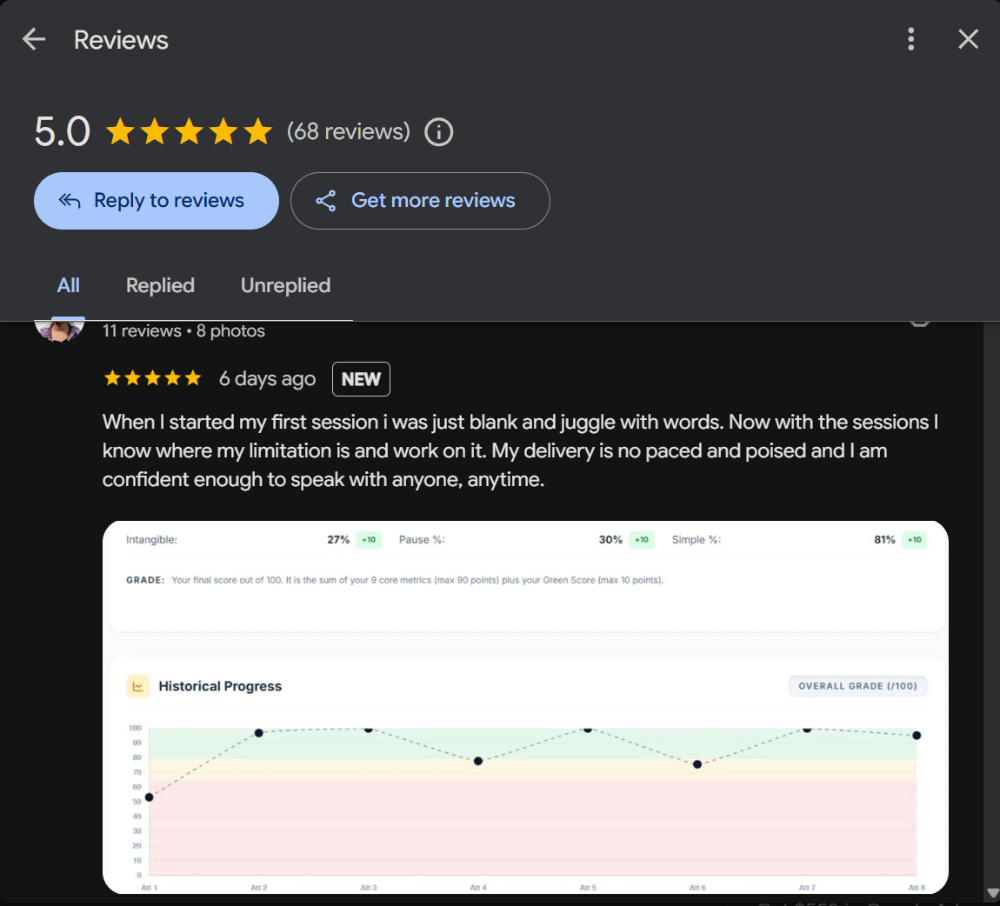
The Personalised Performance Plan is your road to effortless speaking under pressure
After Sonja completed her 4× 1 hour weekly sessions, she became highly confident and effortless in her speaking skills.
Sonja left a 5 Star Google Review showing her consistently high Speech Analyzer App scores.
Sonja is one of hundreds of clients that have achieved speaking success after booking their Speech Assessment and Performance Plan.