
How to Learn Public Speaking Online For Free
This page is about acquiring the permanent ability to speak confidently, without a script, with full control over your decisions, thoughts, voice and body.
We use quizzes, course exercises, video demonstrations, and an AI Chatbot to help you practice, assess your performance, and progress your speaking skills efficiently.
It’s a 5 Step Process to progress multiple communication skills along the Fitts & Posner Model of Skill Acquisition curve:
Theory Practice: Theory Practice is about being able to explain a skill, spot it when you see it, and know what was done wrong and right. Use my AI Chatbot to complete multiple quizzes, short answers, and “spot the skill” videos. By developing your knowledge of the major communication skills (and when they are done wrong and right) you are developing your ability to “self-correct correctly” when practicing. This is essential to getting better every time you practice, and not spend hours without progressing.
Mass Practice: Mass practice is about practicing simple versions of each skill, in isolation, over and over again. Complete the video walkthrough courses for each skill. By recording yourself (and comparing your performance to mine on video) you will be able to increase your performance and lower how much you need to strain and pay attention to doing the skill properly. It will start becoming automatic and accurate. This is essential for being able to eventually do these skills under pressure in specific real life situations.
Specific Practice: Specific practice is about practicing the skill in realistic situations. Complete the video walkthrough courses, and use the AI Chat Bot to help you generate your own specific scenarios. When you record yourself doing the realistic speaking scenarios, my AI Chatbot can also assess the transcript and give you feedback on what you did wrong and right. Being able to self-correct correctly in specific scenarios is essential for being able to perform well in real life situations on a normal conditions, but also when conditions are really hard (e.g. you get hard questions, technical problems happen in the room, or the people you are speaking to challenge you).
Hostile Practice: Hostile Practice is about practicing a skill in situations that are harder than expected. Complete the video walkthrough courses, and use the AI Chat Bot to help you generate your own Hostile Scenarios. Hostile scenarios will put added pressure on you in the form of: time constraints, word constraints, difficult questions, “strawman” replies (where your point will be miss-understood and you have to correct it), objections, etc. Hostile Practice is essential for making skills permanent, successful in any situation, and giving you the capacity to perform multiple skills to a high level of performance with very little attention or cognitive load.
Combine Practice: Combine Practice is learning how to do 2 or more skills at the same time to a high level of performance with little attention or cognitive load. Complete the Combine quizzes, Combine Practice Video Walkthrough Courses, and use the AI Chat Bot to help you self-correct and generate your own Combine Scenarios that progress through theory, mass, specific and hostile practice scenarios. Combine Practice is the final and endless frontier of skill mastery. If you persist with Combine Practice, you will be able to perform 8 or more advanced communication skills, simultaneously, in any pressure situation. Your ability to explain things clearly, to anyone, with humour or emotion will be effortless.
A public speaking course for answering questions confidently with full control over thoughts, voice and body
Public Speaking Skills Before Training with Tom Hendrick
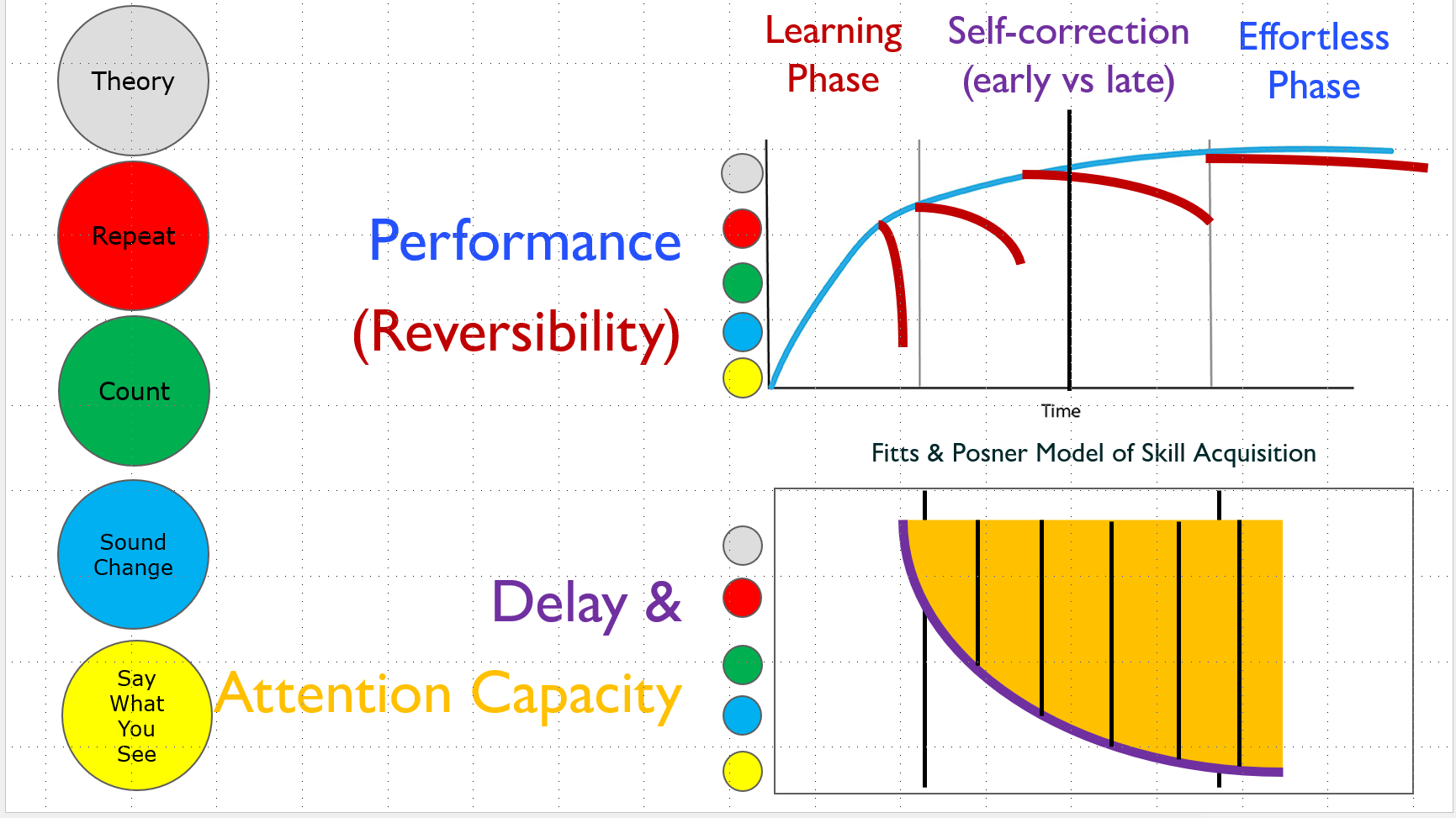
Let’s say you want to get very good at answering questions confidently, with clear structure, while effortlessly using your voice and body naturally, with no nervousness or hesitation.
This is how we will do it…
Look at the Top Graph
The Blue Curve is going up, which shows that your ability to perform public speaking skills is getting better and better.
The Red Lines go down fast in the Learning Phase, slower in the Self-correction Phase, and hardly go down at all in the Effortless Phase. This shows how you lose knowledge and performance very quickly when you start learning a skill. However, you essentially acquire skills forever once they are mastered or Effortless.
The Coloured Circles represent different public speaking skills. If you haven’t done any training, you won’t have progressed any of these skills up the Skill Acquisition Curve.
Now Look at the Bottom Graph
The Purple Curve is almost infinitely high at the start, but quickly goes down over time. This shows delay, or how long it takes you to notice if you’ve done a skill right or wrong. When you’re starting a new skill, you have no concept of what makes it right or wrong, so it takes “infinite” time to figure that out. However, the more you practice it takes you less and less time to notice errors.
The Orange Space shows your attention capacity. When you’re learning new things, your brain has to strain to remember how that new thing works. This has a heavy “cognitive load” which makes you incapable of noticing other things when you’re calculating new knowledge. But in public speaking, the more you practice the more you can perform skills effortlessly and have attention capacity to spare on other things.
For example, a basketballer can dribble the ball in advanced ways, without looking at the ball, but instead spending their attention on their players while avoiding opponents. They are doing multiple advanced skills, to a high level of performance, simultaneously, with attention capacity to spare.
Public Speaking Skills After Training with Tom Hendrick
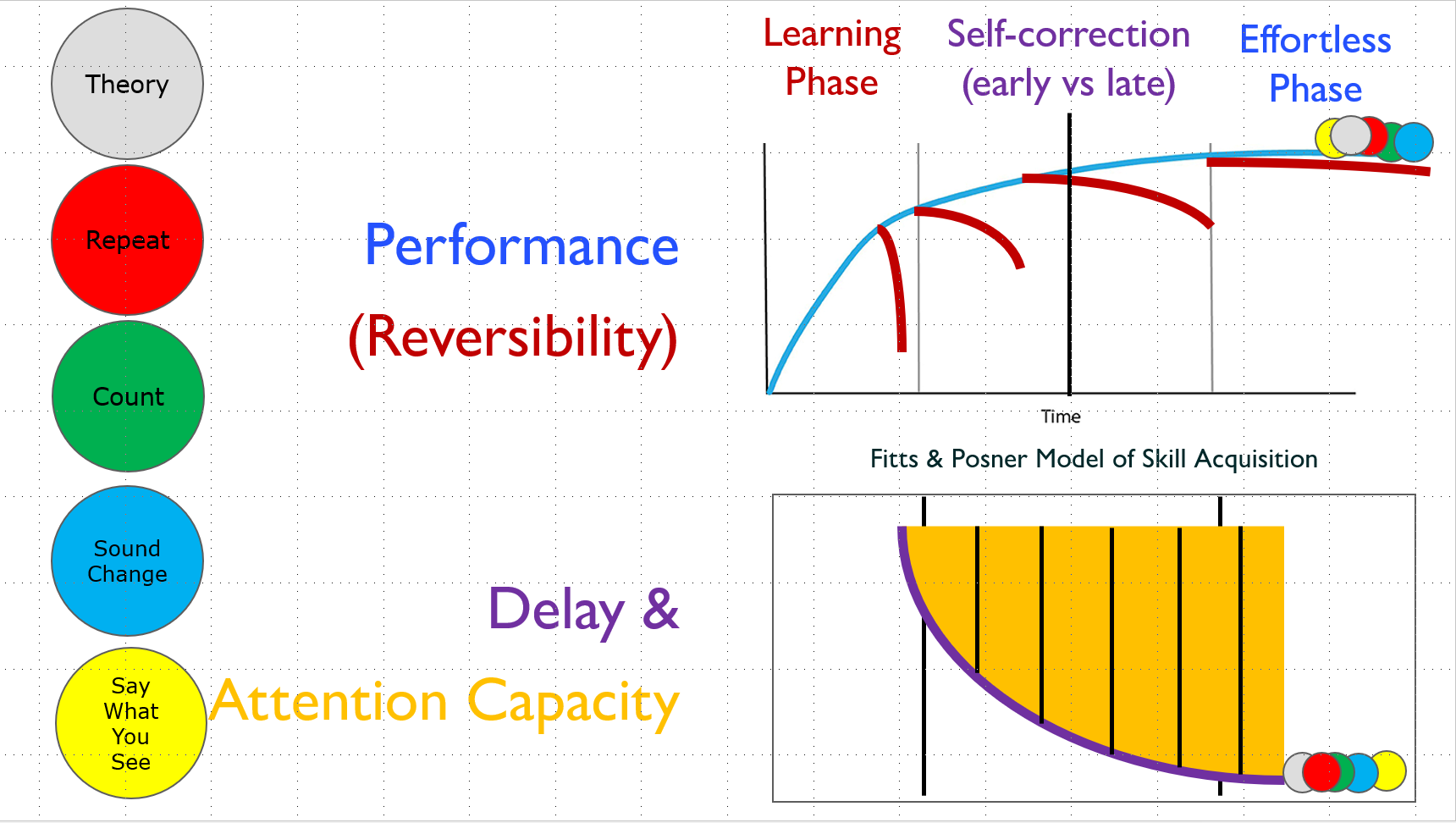
These graphs now represent what your speaking skills will look like after you’ve done some training with Tom Hendrick.
Look at the Top Graph
All of the speaking skills have progressed along the Blue Curve. You now have deep understanding of public speaking concepts (grey, Theory), you can easily access the right words in your intelligence (red, Repeat), you can structure your thoughts into advanced story or explanation structures (green, Count), you have complete natural mastery over your voice (blue, Sound Change), and you can combine words to create vivid images or stories to explain things easily and engagingly (yellow, Say What You See).
Look at the Bottom Graph
You can summon each of those 5 skills without thinking too hard. In the same way it feels weird to hold a pen incorrectly, it now feels weird not to use advanced speaking concepts correctly. These skills come out fast, without hesitation, because they are established habits now. That means you have a huge attention capacity to be present when you speak, noting subtle details like the audience’s reactions to your performance. You spot someone enjoying your explanation, so in real time you flesh out the story even more and come up with a more brilliant ending for that specific audience in that very moment.
You are now a far better speaker without a script, than with a script.
Your progress after Theory Practice
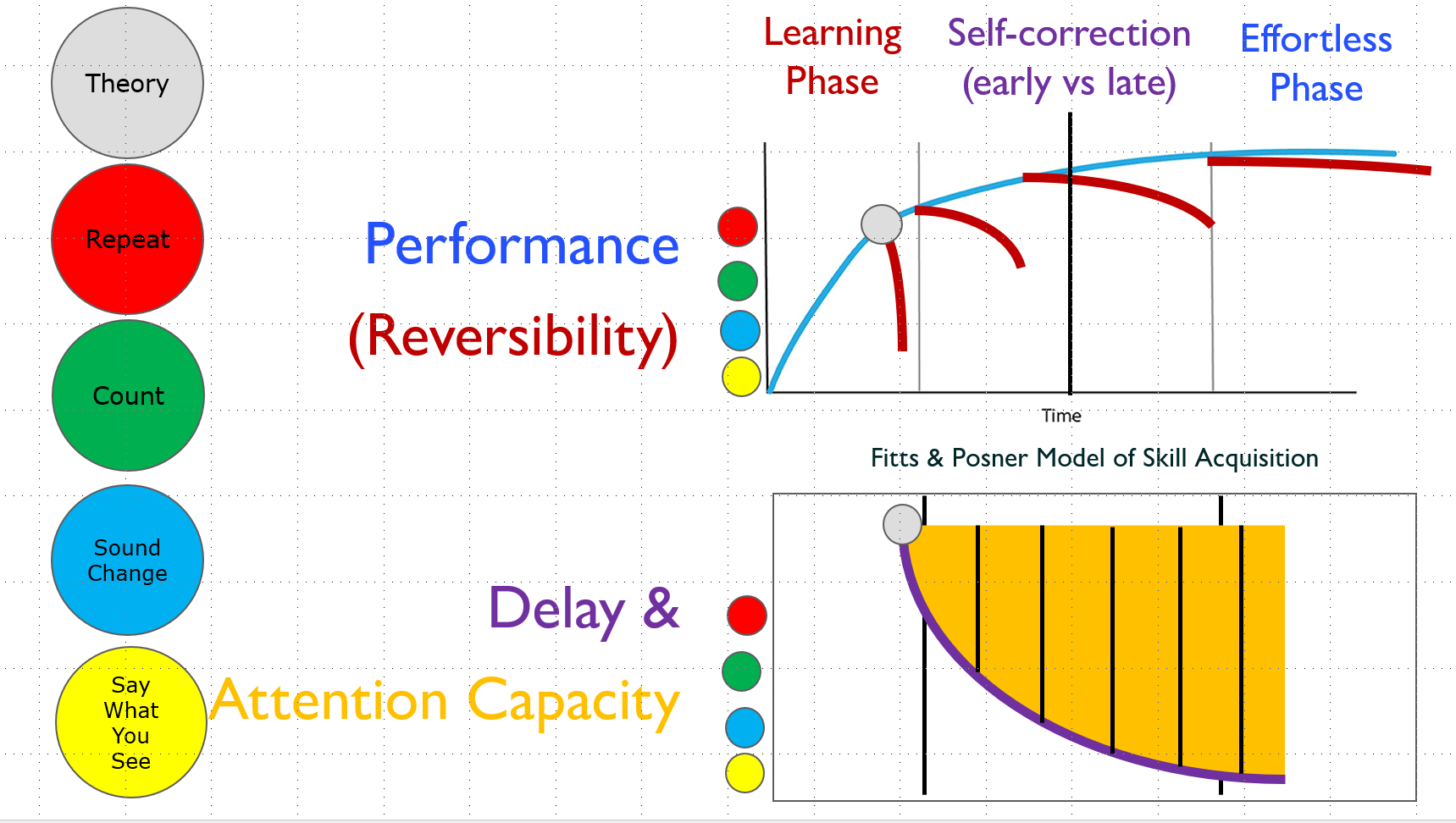
We would start with Theory Practice under the Repeat & Count course.
Before you event start any of the quizzes or “spot the skill” exercises, you will have no understanding whatsoever about Repeat & Count, what it is, when it is does wrong or right, or why we use Repeat & Count.
Look at the Top Graph. The “grey” theory skill would be at the bottom left (no performance, and you’ve spent no time practicing).
If you only did 30mins of passive reading and watching Theory Practice, your grey Theory skill has progressed significantly! Suddenly you’ve learnt a lot about the concepts of “Repeat”, “Count”, “self-regulation”, “co-regulation” and “word association”. You might get 10 out of 10 on a quiz! And you can see when Repeat & Count is done well and not so well.
You then go to sleep and try again a week later. Suddenly, you forget things. You only get 2 out of 10 on the quiz. This drop in performance in a short space of time is shown by the red reversibility lines. In the Learning Phase, performance is low (you can’t ride a bike well after reading how to ride a bike) and skills / knowledge comes and goes quickly.
Look at the Top Graph again . Your grey theory skill just went from the bottom, to the top of the learning curve - but the red line shows your knowledge is at risk of quickly going to the bottom of the learning curve again.
Now look at the Bottom Graph (orange and purple). This shows that answering these basic questions about Repeat & Count takes a lot of mental strain (cognitive load). You have to think really hard and it’s all you can focus on. it takes you a long time to come up with an answer you’re not very confident about.
How do we progress from here?
Here’s the good news! It won’t take you 30 mins to learn everything you lost again. It will take about 1 minute to regain your knowledge if you did the exercises yesterday, about 5 minutes if you did the Theory Practice week ago, and about 15 minutes if you did it 2 or more weeks ago. Reversibility is steep in the early stages of skill acquisition. But Reversibility is less severe as you climb up the skill acquisition curve.
That’s why you can’t just watch and read about public speaking, you have to do exercises and self-correct your performance.
That’s why we provide "quizzes”, “spot the skill” exercises, and an AI Chatbot to help you self-correct. This turns learning from passive to active. Specifically, quizzes and spot the skill exercises are a form of “mass practice”.
Your progress after Mass Practice
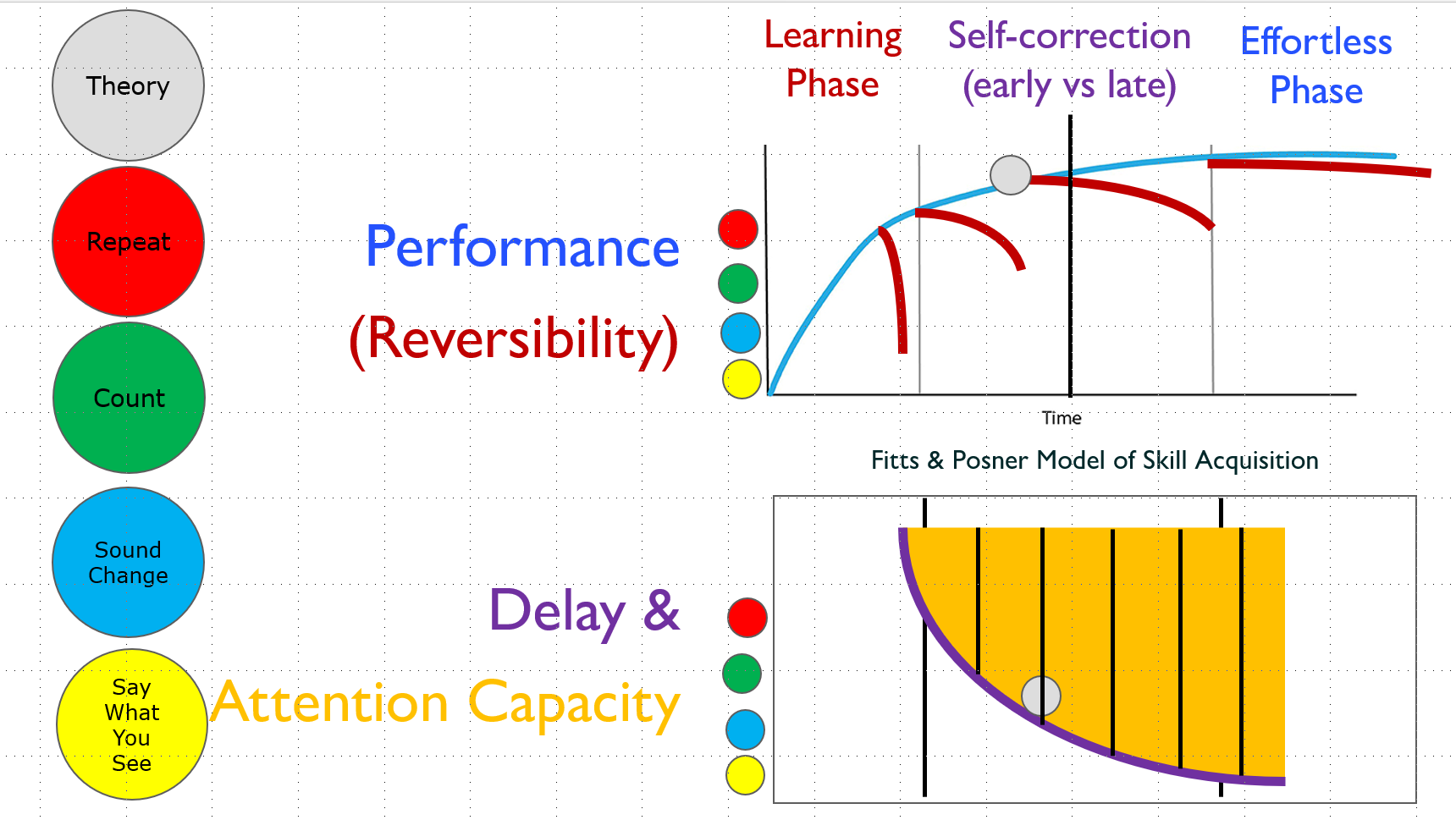
Instead of just reading or watching, you have now done multiple quizzes, multiple spot the skill exercises, and you have received lots of AI Chatbot Feedback.
You’ve done similar things over and over again for about 30mins now, it’s almost getting boring if it wasn’t so rewarding to feel overwhelming rapid improvement.
That’s the feeling of approaching effortless. You’ve quickly gone from no idea, to capable.
You still make mistakes but you get better and better every attempt.
You notice it still feels hard, but it doesn’t take as much mental strain anymore. Let’s break that down.
Look at the Top Graph
The grey theory skill is higher up the performance curve. You have a deeper understanding of public speaking concepts. Furthermore, if you didn’t practice for a week, you wouldn’t forget as much as you did when you were still in the Learning Phase.
But you are still in the early self-correction phase. This means that you’re still relying on the quiz, a recording, or a coach to fix or correct your errors.
However, you are developing “intrinsic feedback”. Intrinsic feedback is your ability to notice what is wrong or right about your own performance.
Once you can say things like “that’s not quite right”, “instead of this, I should have done that”, or “the second example is better than the first because…”. That’s when you’re ready for Specific Practice.
Look at the Bottom Graph
Because you have done so many repetitions of quizzes, spot the skill exercises, etc… your delay has gone from infinite to barely over a second delay. That’s a huge leap but there’s still a long way to go to get “instantaneous”.
You now feel like you’re in a rhythm because you have some (not much) attention to spare when performing the speaking skill.
Your progress after Specific Practice
After 2 hours of mass practice, you have done Theory Quizzes, Spot the Skill exercises, but also lots of spoken answers to practice questions using the Repeat & Count skills.
Your theory knowledge has deepened as you have learnt some advanced nuances about how best to Repeat & Count and what not to do.
Not only have we done playful and isolated exercises, but we are now starting to put these skills into real world scenarios.
Look at the Top Graph
After 2 hours, you now have the ability to do 3 skills almost effortlessly in a specific work-related scenario.
S ctice sessions later and
You’ve done similar things over and over again for about 30mins now, it’s almost getting boring if it wasn’t so rewarding to feel overwhelming rapid improvement.
That’s the feeling of approaching effortless. You’ve quickly gone from no idea, to capable.
You still make mistakes but you get better and better every attempt.
You notice it still feels hard, but it doesn’t take as much mental strain anymore. Let’s break that down.
Look at the Top Graph
The grey theory skill is higher up the performance curve. You have a deeper understanding of public speaking concepts. Furthermore, if you didn’t practice for a week, you wouldn’t forget as much as you did when you were still in the Learning Phase.
But you are still in the early self-correction phase. This means that you’re still relying on the quiz, a recording, or a coach to fix or correct your errors.
However, you are developing “intrinsic feedback”. Intrinsic feedback is your ability to notice what is wrong or right about your own performance.
Once you can say things like “that’s not quite right”, “instead of this, I should have done that”, or “the second example is better than the first because…”. That’s when you’re ready for Specific Practice.
Look at the Bottom Graph
Because you have done so many repetitions of quizzes, spot the skill exercises, etc… your delay has gone from infinite to barely over a second delay. That’s a huge leap but there’s still a long way to go to get “instantaneous”.
You now feel like you’re in a rhythm because you have some (not much) attention to spare when performing the speaking skill.
Free 1 hour public speaking course
Choose a free online public speaking course
Speak Without Notes (Repeat Count technique)
Learn Repeat Count to speak confidently and clearly without any preparation.
Great for Q&A, job interviews, impromptu speeches.
Storytelling 1 (Say What You See technique)
Learn to make speeches spark imagination and more engaging.
Great for Youtube videos, podcasts, conference presentations.
Storytelling 2 (Conflicted Conversations technique)
Learn to tell professional stories and keep audiences hooked and wanting more.
Great for Keynotes, Workshops and competition speeches.
Coming soon: see video here
Vocal Strength & Stability
A must-do workshop for everyone. Challenge your articulation and vocal variety.
Great for overcoming mumbling and developing a strong voice to make you feel confident.
About Free Public Speaking Classes
Join a weekly online class with Tom Hendrick every Friday, bring a friend!
Fun Fridays: Free Weekly Online Public Speaking Class with Tom Hendrick
About Tom Hendrick’s Weekly Free Online Public Speaking Class
Learn public speaking skills for fun at this free weekly online workshop. Learn & practice different speech structures and techniques to improve your confidence and impact. You can also just spectate until you feel confident enough to try.
Every participant gets free resources, templates and activities to measure and further their public speaking improvement.
Tom Hendrick is recognised in the Top 10 best online public speaking coaches. Join every Friday lunch for a fun & free 1 hour public speaking workshop. Once you've participated in 4 weekly sessions you will be a drastically improved speaker.
Reviews about Tom Hendrick’s Public Speaking Coaching

Tom Hendrick is a fountain of knowledge. He delivers public speaking coaching with a sense of playfulness and creative focus. He made presenting look very doable, while helping to break tasks into workable elements, while holding space for my ideas and passion.

I highly recommend booking some public speaking coaching with Tom Hendrick. I recently had a public speaking coaching session, and Tom was very good at helping me organise my ideas, turn complex information into an impactful presentation, and teaching me how to apply his public speaking structures and techniques. I left the session with a lot of knowledge on how to make better choices with my content and delivery to suit my audience. Tom's public speaking coaching is confidence-building, insightful and practical, and can prepare anyone to write, practice and perform a meaningful piece of work that can heavily engage all audiences.