
Learn Public Speaking Skills with Diagnostics & Coaching Plans
Mastering Public Speaking: The Science of Skill Acquisition
For many professionals, public speaking feels like an impossible hurdle. You might be incredibly articulate in one-on-one conversations or team meetings, but the moment you step onto a stage or face a high-stakes pitch, your mind goes blank, and your confidence crumbles.
The truth is, public speaking is: "an infinitely complicated game." Much like a chessboard has more move combinations than there are atoms in the universe, the first word you choose in a presentation has an infinite number of possibilities. By the time you reach your tenth word, the combinations are staggering, which easily leads to overwhelm, nervousness, and analysis paralysis.
To master the “game” of communicating well under pressure, we don't just need a few tips and tricks; we need to rely on the proven science of skill acquisition. By understanding how the brain learns and automates new behaviors, anyone can transform from a nervous speaker into a confident, captivating communicator.
That’s why we need to do a Diagnostic of your speaking skills and design a Coaching Plan for you, specifically.
If you want Tom Hendrick’s step-by-step training method guide, it’s here.
If you want to know each term in Tom Hendrick’s Model of Skill Acquisition for public speaking, read on.
The Real Problem: Skill Inhibition vs Not Skill Acquisition
The most important thing to realize is that you already know how to speak. You do not have a skill acquisition problem; you have a skill inhibition problem.
When you stand in front of a crowd, a primitive, involuntary part of your brain called the amygdala detects a threat to your reputation. It activates your sympathetic adreno-medullary system, flooding your body with adrenaline and cortisol. It is helpful to group these typical triggers:
Flight: Getting uncomfortable before you present. Cutting presentations short, exhausting yourself with over-preparation.
Freeze: Getting uncomfortable during your presentations. High heart rate, fidgeting, going black or having a self-critical mind.
Fawn: Getting uncomfortable giving bad news or interruptions. Conceding, saying what they want to hear instead of being direct.
Fight: Getting uncomfortable getting bad news or interruptions. Becoming overly-energized, intimidating, or un-diplomatic.
Because these reactions are involuntary, you cannot simply "choose" not to be nervous. However, by treating public speaking as a physical and cognitive skill, we can build routines that bypass this inhibition.
Public Speaking & Tom Hendrick’s Model of Skill Acquisition
To reliably cure public speaking skill inhibition, we use Tom Hendrick’s Model of Skill Acquisition, which incorporates many established concepts proven since the Fitts and Posner Model of Skill Acquisition 1967. Fitts and Posner claimed there were three distinct stages every human goes through when learning a complex skill. Tom Hendrick’s testing with hundreds of clients applies that model to public speaking skill development, and splits the Associative (Self-Correcting) phase into early and late phases. The Step-by-step training method guide is here.
1. The Cognitive (Learning) Phase
In this initial stage, your attention to the skill is extremely high, but your performance is very low. When you try to use a new communication technique, you will hesitate, overthink, and make mistakes (measured by latency). Crucially, in this phase, skill reversibility is rapid—if you learn something today but don't practice it, you will forget almost all of it by tomorrow.
This is why most public speaking classes or courses aren’t effective. You feel good because you learn a lot quickly, but it doesn’t last. If you had to do your high school or university exams again today, would you be better? Probably not. Because those theoretical skills never progressed far past the Learning Phase, they never got “cemented”.
2. The Associative (Self-Correcting) Phase
As you practice, you enter the self-correcting phase. In the early self-correcting phase your performance gets better, and the amount of active attention you need drops. At first, you won't realize when you make a mistake unless a coach or a video recording points it out to you. But soon, you develop intrinsic feedback—you catch your own mistakes in real-time and correct them faster and faster.
3. The Autonomous (Effortless) Phase
This is the holy grail of public speaking. Performance is consistently high, and the attention required is virtually zero. It becomes as automatic as holding a pen or riding a bike. Once you reach the effortless phase, the rate at which you forget the skill becomes glacially slow. Can you imagine how long it would take you to forget how to hold a pen correctly? The same is true of public speaking skills. You could stop public speaking for ten years, and within a ten-minute warmup, you’d be right back to your peak performance.
Reaching the Effortless Phase in Just 4 Hours
The incredible news is that because you already possess the underlying vocabulary and intelligence, un-inhibiting your brain to reach the Autonomous Phase only takes about four 1-hour sessions.
By practicing deliberately—say, one hour a day for four days, or one hour a week for four weeks—you create the adaptive stimulus your brain needs. Once the brain realizes that specialized speaking frameworks are safe and familiar, it stops triggering the amygdala's panic alarms and lets your natural personality shine through.
The 3x Core Skills of Effortless Communication under Pressure
To become a master speaker, we train your brain to automatically execute three internal processes under pressure [7]:
1. Self-Regulation (performance descends to level of training)
The answer to pressure, and the sympathetic adreno-medullary system’s (SAM) involuntary panic, is to start a familiar routine. When your SAM detects a familiar speaking routine, this acts as a self-regulating signal instead of a panic button. This calms your brain down and keeps it focused on thoughts & habits that are productive to good speaking, while reducing distractions and panic.
"When you are nervous, the answer is to do that which you have trained yourself to do automatically. Do not try to do more. Do not try to be perfect. Just do what you know how to do."
Dr Bob Rotella (author of How Champions Think, and Golf is Not A Game of Perfect)
2. Co-Regulation (audience needs early signs of confidence, credibility & value)
Audiences panic too when you speak to them. Because just like your SAM is receiving signals that it is predicting as threatenting or not… you are putting out signals for your audience’s SAM. Have you ever seen a speaker immediately deflect a question? Or starting rambling abut something else for hours? Or misunderstand the question, start answering the wrong question, and no one does anything to stop them? These are common things speakers do to create “co-disregulation”, meaning the audience starts disliking you early into your presentation.
3. Word Association (From one word, many. Your brain working in the background)
Giving your brain a structured prompt (like a single word) that instantly "zip-files" and unlocks thousands of relevant thoughts, preventing you from rambling. Starting an answer to a question by saying “That’s a good question” is a bad habit. It causes word Dissociation… because your brain will start to think about all the reasons why that was a good question … which was not the question…
Instead, if the first words/ sounds/ gestures that come out of your mouth are about the question itself, then Word Association happens very productively in the background. Here is an illustration.
The Questioner says: “What’s the biggest challenge facing your industry?“
The SAM System thinks: (“Ahh. Big question. Where to start? Going blank. Panic. Run.“)
You say: [Repeat: Operative Word] “Biggest Challenge”.
The SAM System thinks: (“What would I say is the Biggest Challenge? Depends on Me or Others?”)
You say: [Count: Me/Others]: “I can talk about my biggest challenge in the industry or the industry generally.”
The SAM System thinks: (“I now have an answer about my biggest challenge. Still need time to think about the industry“)
Questioner: “Tell me about both“. (“That’s a good point. This person already has an answer and won’t waste my time.”)
You say: “So by biggest challenge is different to the industry generally… as a small startup, my biggest challenge is about getting the business going. Whereas, the industry itself has been around for a long time, it’s about adapting to change and unpacking those old and expired ways of working. I think that gives me a potential advantage if I can get the business going quickly.“
The SAM System thinks: [“Whoa! I’ve never had that insight before. Sometimes my repeat & count skills surprise even me.“]
Why get a Diagnostic and Coaching Plan with Tom Hendrick?
When you train with Tom Hendrick, we can achieve all of the above essential skills very quickly in your Diagnostic and Coaching Plan.
We do this by by drilling constraint-based frameworks (like Repeat, Count, Say What You See, Sound Change, etc) until they are second nature. The most basic of these frameworks (and very powerful) is the Repeat and Count Technique (shown above).
Repeat (How good you are at receiving a prompt and putting it into words)
When asked a question, you confidently repeat a Word, the Sentence, or Clarify the question into two parts. This buys you time to think, ensures you answer the right question, and starts productive word association.
Example of Repeat Word
Q: Would you invest in a bakery?
A: Bakery… [answer with a Count Structure]
(Note: even a word from the question is enough to start self-regulation, co-regulation & word association.)
Example of Repeat Sentence
Q: Would you invest in a bakery?
You Say: “Would I invest in a a bakery? I might invest, depending on… [answer with Count structure]”
Example of Repeat Clarify
Q: Would you invest in a bakery?
You Say: “To clarify, is this a small startup bakery? Or a big established bakery? [answer with Count structure]”
Example of Repeat Sight
Q: The Best Man didn’t arrive. Say a few words to the Bridge & Groom in front of everyone.
You Say: “I see a beautiful Bride, a Groom with a huge smile on his face, and a room full of dear friends & family.”
(Note: Instead of repeating words, they repeated what their eyes could see. Past Present Future is a good count structure in this situation, because speaker could talk about the first time he met the Bride & Groom, what they are like today, and what their lives might look like in the future.)
Example of Repeat Feeling
Q: This is unacceptable! What are you going to do to fix the mess you’ve made!?
You say: “I can sense frustration. I agree… unacceptable. This is how we’re going to fix this. [answer with count structure].”
(Note: Here, both the words and the “feeling” is being repeated for high levels of co-regulation, self-regulation and word association).
Example of Repeat Purpose
Q: [no prompts given, but you’re about to Welcome a room full of guests to a major event]
You say: “I’m here to welcome you all today and start today’s event. There are 2 things you need to know [answer with Count].”
Count (How good you are at splitting one idea into two or more comparable ideas)
Before rambling, you declare the structure of your answer upfront. You might use Summary & Detail ("No, and here is why"), One Hand & The Other Hand ("For extroverts it looks like this, for introverts it looks like that"), or Problem Options Solution, and many more.
The best Counting structures are not arbitrary, they are deliberately chosen personal constraints by you under pressure to make it hard to give a bad answer. Good options include Comparables (two-step structures that split a question into opposite ideas) or Patterns (three-step structures that reveal a trend).
Examples of Comparables
Wrong vs Right
Me vs Others
General vs Specific
Past vs Future
Small vs Big
Summary vs Detail
One Hand, other Hand
Etc
Examples of Patterns
Past Present Future (a pattern of time)
Bad Better Best (a pattern of quality)
Small Medium Large (a pattern of size)
Problem Options Solution (a pattern of progression)
Good Bad Worst (a pattern of regression)
Etc
Advanced Public Speaking: the Audience-centric Framework
Repeat & Count is but one public speaking skill or “choice” in the Audience-Centric Framework.
The entire framework uses principles of game theory to help you make good choies in the infinitely complex game of public speaking. This is similar to how Chess Grandmasters can consistently play chess at a high level, despite how many move combinations there are.
If you want to learn the whole framework, you will need to master the following concepts and skills:
Outcomes vs Reactions vs Choices
Outcomes are what happens after all you have said is finished. What can the audience actually do with the presentation you have delivered? Let’s look at 3 possible Outcomes:
Decision: what is the exact question you are asking the audience to say “yes” or “no” to?
For example, if you are an entrepreneur pitching for funding you have to decide if the real question is: “Do I want to invest $1 million?” or is it “is this idea worth another longer presentation with my boss in the room?” or is it “Did this pitch score the highest according to the pitch competition checklist?“
Restatements: what can the audience actually say themselves? This is essential for education, branding, or advocacy.
For example, if your point is paragraphs long, the audience might only say: “That was a complicated presentation“. But if your point is reduced to a diagram the audience can draw themselves, then they can re-draw it for others and re-explain what each part means.
Liking: how much an audience enjoyed you and your presentation. This is essential for relationship building.
For example, all things being equal the entrepreneur who is most liked in the pitch competition will probably be rewarded the deciding point - or receive the most interaction / memorability / praise / opportunities after the presentation.
Reactions is how the audience communicates to you during the presentation.
Choices are the word structures, gestures and vocal delivery Choices you make to get desired Reactions & Outcomes.
Reactions & Choices essential for Decision Outcomes
Agreement: looks like head-nodding, note taking, asking questions that accept and add to the points you made. Decisions can fail for a lack of agreement (Audience might say: “that isn’t a problem“). Agreement problems can be solved using the Familiar Unfamiliar choice, below.
Value: sounds like audiences going “ooohh” or realising the scale & significance of things. Decisions can fail for a lack of value (Audience might say: “I agree it is a problem, but it is not big enough of a problem to worry about“). Value problems can be solved using the Comprables & Pattern choices, above.
Trust: sounds like audiences continuing information favorably. Decisions can fail for a lack of trust (Audience might say: “I agree it is a big problem, but I can’t see that happening to me“). Trust problems can be solved by using a combination of Repeat Count and other choices. The aim is to find and Repeat the word that has bad regulation or word association for the audience, and replace it with a different idea that establishes a better pattern. Problem Options Solution is a great pattern for this.
Reactions & Choices essential for Restatement & Liking Outcomes
Processing Fluency: looks like the audience being able to recall and restate what you said. Restatement & Liking can fail for too much audience “strain” to understand the information. Processing Fluency problems can be solved with Comparables, Patterns or Say What You See, as audiences are good at remembering opposites, patterns, or images they can see and draw themselves. The more a part of the idea explains the rest of the idea, the more processing fluency it has.
Alert: looks like the audience looking at you with focus, and not being distracted by their phone or something better to do. Restatement & Liking can fail for a lack of interest or focus. Sound Change (and Sight Change) are choices that grab the audiences attention by timing when and how you move your voice, slides or body. The eyes and ears involuntary give fresh attention to new things and stimulus.
Imagination: “looks like” the audience generating images in their heads, prompted by the visually descriptive words you choose to say. Restatement & Liking can fail for a lack of sensory enjoyment and connection to the content. There are lots of storytelling choices to add more sensory enjoyment and interaction:
Say What You See: choosing visually descriptive words over abstract and general words
Sound Change: changing the timing and delivery of your voice causes information to travel on the sound wave
Sight Change: changing the slide or the way things appear causes information to travel on the light wave
Personal Tangible Intangible (or Man, Map, Message): ordering and balancing content from vivid first person perspective (Man), to tangible image (Map), to intangible general idea (Message). This ensures a healthy balance of engaging and abstract content, so as to avoid a boring lecture.
Conflict: a form of Comparable storytelling that puts ideas or people in a clashing unresolved state that illicits imagination on from the audience and a desire to know what happens next to resolve the conflict. External Conflict involves things you can see (two people having a fight, who will win who will get hurt?). Internal Conflict involves things you can’t see (doubts, struggle, getting a question and not having the right answer). Growing Conflict involves a domino effect of one thing happening that will trigger more things (a lie gets discovered and now many relationships fall apart).
Conflicted Conversations: a structure that uses you Comparables, Sound Change, gestures and Conflict to embody a conversation between two or more people who have conflicting personality traits and objectives. Maximises Alert and Imagination.
Choose your own Adventure: describing a person in a moment with choices & consequences, and inserting a hypothetical question to engage the audience to simulate or consider the choices in their head. This avoids the pitfall that most stories are told at audiences, instead of inviting them to “imagine”.
Storycircle: an advanced 9-step storytelling framework that uses all Choices. Inspired by Joseph Campbell’s Hero With 1,000 Faces, Chris Vogler Storyboarding Work with Disney, and Dan Harmon’s Story Circle.
Good News vs Bad News: Acquiring Public Speaking Skills
The Bad News: you can never completely remove the nervousness you can feel public speaking. Your amygdala is involuntary.
The Good News: you can learn powerful self-regulation, co-regulation and word association skills that allow you to speak to a high standard (forever) despite maximum pressure and stress.
The Bad News: this seems like a lot of technical content, maybe you think you’re not smart enough.
The Good News: this method has worked for hundreds of clients, and although it seems complicated, so is learning to ride a bike. Remember, you likely don’t have a speaking acquisition problem, you have a speaking inhibition problem. You already know how to speak confidently, clearly with personality - it just goes away under pressure. You can do exercises to get natural under pressure.
Mastering public speaking is not an innate talent reserved for the lucky few. It is a predictable, mechanical process of skill acquisition. By utilizing the Tom Hendrick Model of Skill Acquisition (a compilation of proven studies stemming from Fitts and Posner 1967 applied to public speaking) - through guided, deliberate practice - you can conquer your biological inhibitions, automate elite communication frameworks, and ensure your great ideas never fail for a lack of courage or clarity.
If you would like a free Diagnostic Speech Assessment and Personalised Training Plan, book using the Coaching button below.
For 1 hour Free Coaching, Free Weekly Classes, Videos, Courses, Templates and more to help you measure and master your unique speaking style.
Measure and master your unique public speaking style in Adelaide and online.
Free 1 hour public speaking course
Choose a free online public speaking course
Speak Without Notes (Repeat Count technique)
Learn Repeat Count to speak confidently and clearly without any preparation.
Great for Q&A, job interviews, impromptu speeches.
Storytelling 1 (Say What You See technique)
Learn to make speeches spark imagination and more engaging.
Great for Youtube videos, podcasts, conference presentations.
Storytelling 2 (Conflicted Conversations technique)
Learn to tell professional stories and keep audiences hooked and wanting more.
Great for Keynotes, Workshops and competition speeches.
Coming soon: see video here
Vocal Strength & Stability
A must-do workshop for everyone. Challenge your articulation and vocal variety.
Great for overcoming mumbling and developing a strong voice to make you feel confident.
About Free Public Speaking Classes
Join a weekly online class with Tom Hendrick every Friday, bring a friend!
Fun Fridays: Free Weekly Online Public Speaking Class with Tom Hendrick
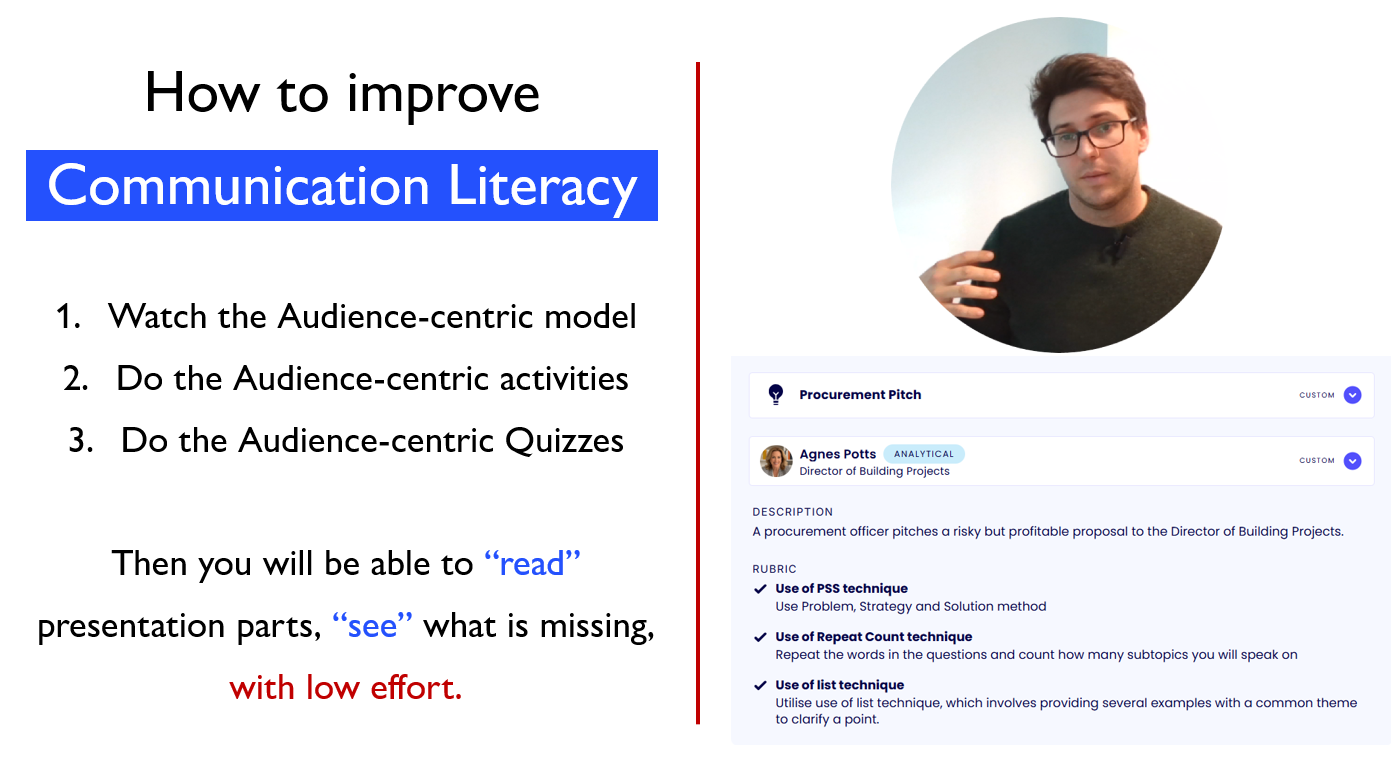
About Tom Hendrick’s Weekly Free Online Public Speaking Class
Learn public speaking skills for fun at this free weekly online workshop. Learn & practice different speech structures and techniques to improve your confidence and impact. You can also just spectate until you feel confident enough to try.
Every participant gets free resources, templates and activities to measure and further their public speaking improvement.
Tom Hendrick is recognised in the Top 10 best online public speaking coaches. Join every Friday lunch for a fun & free 1 hour public speaking workshop. Once you've participated in 4 weekly sessions you will be a drastically improved speaker.
Reviews about Tom Hendrick’s Public Speaking Coaching

5 Star Customer Testimonial:
“Tom Hendrick is a fountain of knowledge. He delivers public speaking coaching with a sense of playfulness and creative focus. He made presenting look very doable, while helping to break tasks into workable elements, while holding space for my ideas and passion.”

5 Star Customer Testimonial:
“I highly recommend booking some public speaking coaching with Tom Hendrick. I recently had a public speaking coaching session, and Tom was very good at helping me organise my ideas, turn complex information into an impactful presentation, and teaching me how to apply his public speaking structures and techniques. I left the session with a lot of knowledge on how to make better choices with my content and delivery to suit my audience. Tom's public speaking coaching is confidence-building, insightful and practical, and can prepare anyone to write, practice and perform a meaningful piece of work that can heavily engage all audiences.”